A sudoku where you draw the boxes
Number Islands keeps sudoku's famous rule but hides the boxes. Here's how it works, and why that one change makes such a satisfying puzzle.
If you've solved a sudoku, you already know most of Number Islands. Every row holds each number once. Every column holds each number once. And the grid is split into regions that also hold each number once.
The twist is that in Number Islands nobody tells you where the regions are. The 6×6 sea hides six islands, each exactly six squares, and finding their coastlines is half the puzzle.
The two rules
- Find the islands. Draw coastlines along the grid lines so the sea splits into six islands of exactly six connected squares. (Connected means side by side, not just touching at a corner.)
- Number them. Fill in 1 to 6 so that every row, every column and every island contains each number exactly once.
Every puzzle has exactly one solution, and you can always reach it by logic. You never need to guess.
The clues
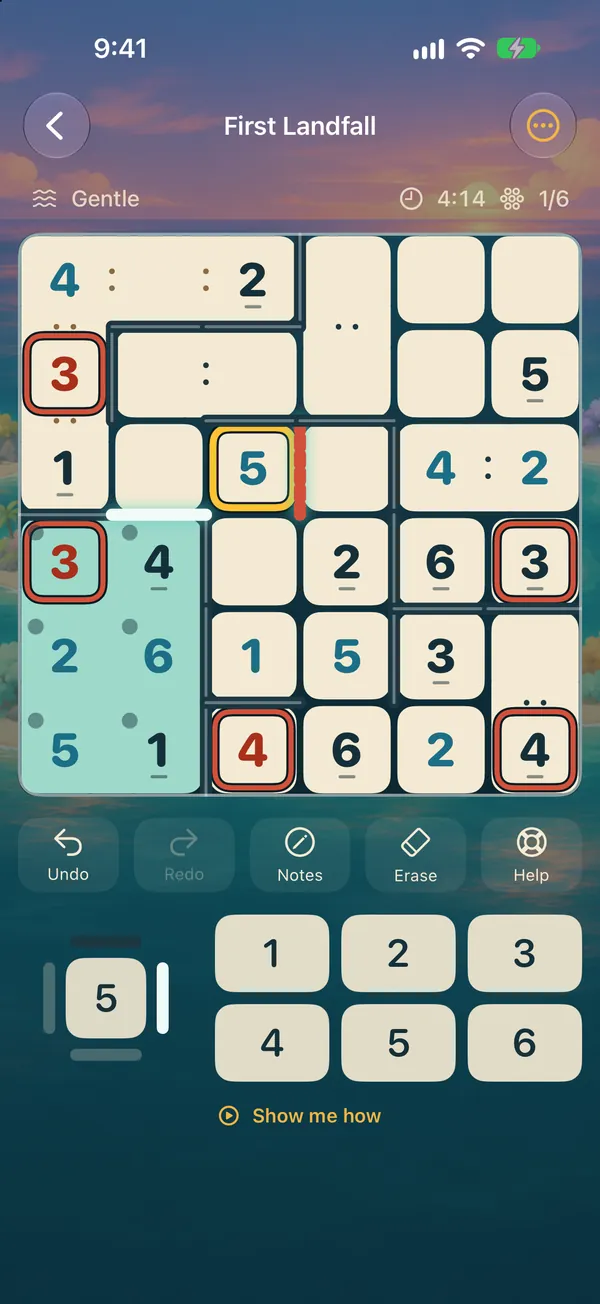
A puzzle starts with three kinds of clue:
- Given numbers, printed in bold. They work exactly as in sudoku.
- Given coastlines, drawn as thick dark lines. The squares on either side belong to different islands.
- Bridges, shown as two small dots (••) across a gap. The squares on either side belong to the same island.
Why hiding the boxes works so well
In classic sudoku the shape of the grid never changes, so after a while you're mostly hunting for numbers. In Number Islands, numbers and shapes push on each other. A pair of 4s tells you two squares can't share an island, which gives you a coastline. A sealed-off pocket of six squares gives you a whole island, which unlocks the numbers inside it. Each kind of discovery feeds the other.
That back-and-forth is where the “aha!” moments come from. It also keeps the puzzle fresh: no two of the 1,001 levels in the app have the same island layout. None is a rotation or mirror image of another.
A family resemblance
Puzzle fans will recognise the idea. Sudokus with odd-shaped regions are often called jigsaw or irregular sudoku. When the solver has to work out the regions too, enthusiasts call the style Chaos Construction. You'll find many examples on puzzle sites like Logic Masters Deutschland. Number Islands takes that idea and makes it friendly: a smaller 6×6 grid, a gentle difficulty curve, and hints that explain every step.
Where to start
The quickest way in is the one-minute interactive guide on our home page. It's the same lesson as in the app. Then print an easy puzzle from The Shallows and try it with a pencil.